Table of Contents
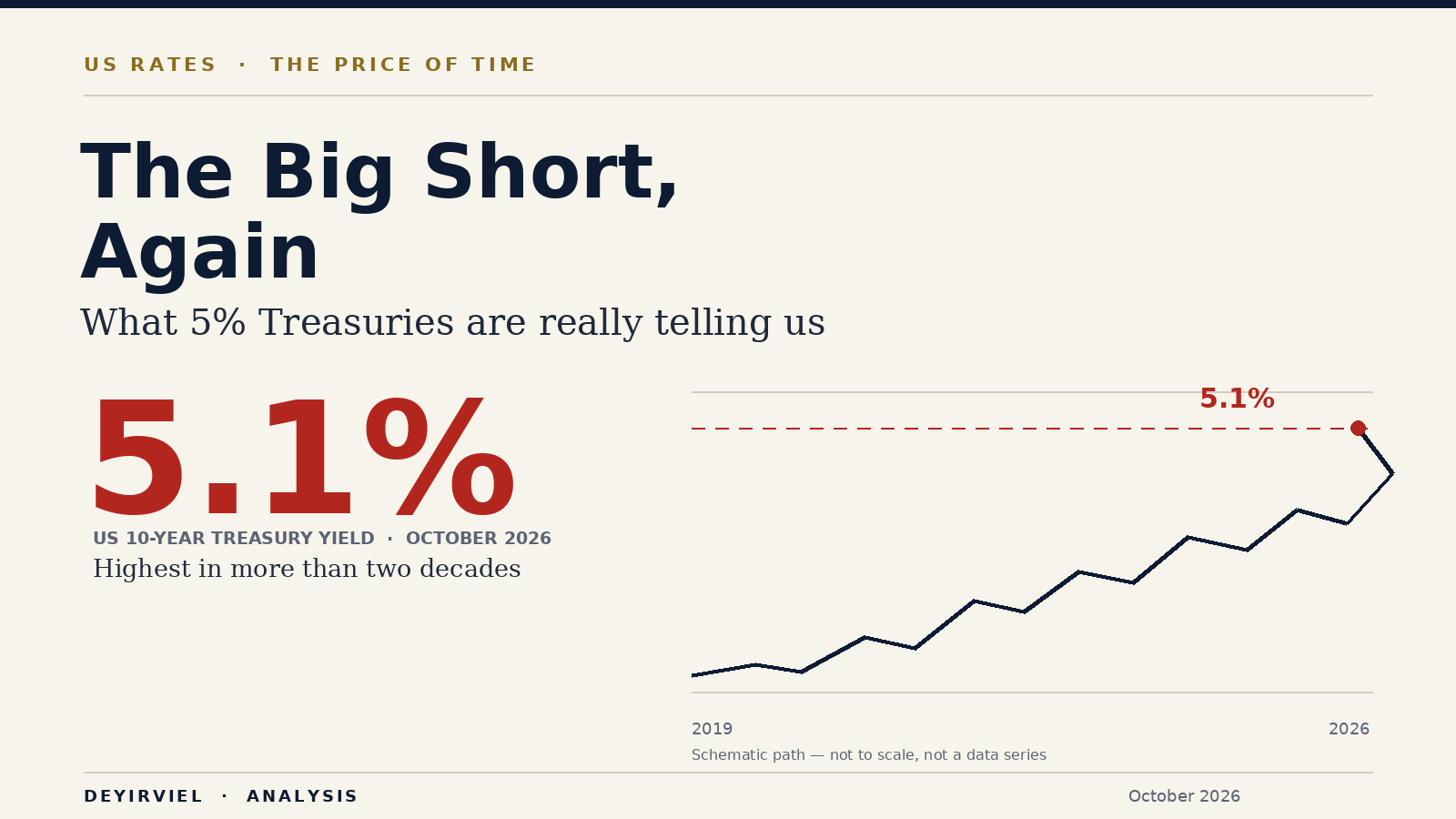
On the screen, the number is unremarkable: 5.1%. One decimal place. You would not cross the street to look at it.
But the US 10-year Treasury is not a stock. It is the price of time in the largest, deepest, most consequential market on earth. At 5.1% — the highest in more than two decades — it is doing something no equity index can do: it is repricing every asset, every mortgage, every loan, every valuation model, every pension, and every bank balance sheet, all at once.
Naturally, the internet has decided this is the next Big Short.
It usually is not. But the people who say that are wrong for the wrong reason. The Big Short was never a bet that house prices would fall. It was a bet that the machine built on top of house prices had been misunderstood by almost everyone inside it. The trade was not “housing is expensive.” The trade was “the fine print says something different from what the sales brochure says, and the people holding the risk cannot survive being right.”
That distinction is the whole essay. Because in 2026 the expensive thing is not a house. It is money itself. And the fine print is not in a mortgage-backed security. It is in the discount rate.
The thing everyone gets wrong about 2008
2008 is remembered as a housing crisis. It was not. It was a debt crisis that used housing as its raw material.
The house was the collateral. The crisis was the structure built on top of it: mortgages pooled into securities, securities sliced into tranches, tranches re-sliced into synthetic CDOs, and credit default swaps written on those tranches by institutions that did not have the capital to pay if the bet went wrong. The rating agencies stamped the senior pieces AAA because their models said house prices in different states would not fall together. They did. AIG sold insurance on the whole thing without setting aside money for the claims. The funding was short-term repo against long-term mortgages — a maturity mismatch that works beautifully until the repo market notices.
The subprime loans were maybe $1.3 trillion. The structures written on top of them were multiples of that. That is the part people forget: the bubble was not the size of the mortgages. It was the size of the claims on the mortgages.
So the Big Short was not a prediction about American homeowners. It was a reading of the fine print. Michael Burry did not short houses. He bought insurance on bonds he had actually read, at prices that assumed the bonds were safe. He was right about the structure and early about the timing, and for a long time that looked exactly like being wrong.
That is the part I keep coming back to, because it is the part that rhymes today.
The Big Short was not a bet that the asset would fall. It was a bet that the financing could not survive the asset being repriced. That is a different trade, and it is the one worth looking for now.
Two kinds of high yield
Before we compare 2007 to 2026, we need to separate two things that are always confused, because they point in opposite directions.
A bond’s yield is two things stacked on top of each other:
Yield = risk-free rate + credit spread.
The risk-free rate is the price of time. The spread is the price of fear.
In 2008, the crisis was in the spread. The Fed was cutting the risk-free rate toward zero; the problem was that nobody knew what the loans inside the tranches were worth, so spreads exploded. The high yield of 2008 was a credit event: will they pay?
In 2026, most of the high yield is in the risk-free rate. The US 10-year is above 5.1%, the German Bund is around 3.6%, and Japanese government bonds are yielding at levels last seen in the late 1990s. This is not primarily a story about investors demanding a bigger premium for corporate default risk. It is a story about the price of time going back up.
That is a different animal. In 2008 the question was will they pay? In 2026 the question is can they refinance? The first is a credit event. The second is a duration event. They rhyme, but they are not the same poem.
The 2008 checklist, run today
Here is the comparison I actually find useful. Not “does the chart look like 2007” — charts always look like something. The useful question is whether the same five conditions are present: leverage, opacity, funding mismatch, valuation dependence, and a belief that liquidity will be there when you need it.
| Question | 2007 | 2026 |
|---|---|---|
| What is the trigger? | Floating-rate mortgages reset; home prices stall | Cost of money resets higher; refinancing wall; term premium returns |
| Where is the leverage? | Households, banks, broker-dealers, off-balance-sheet vehicles | Governments, private credit, leveraged funds, the Treasury basis trade, commercial real estate |
| Who is opaque? | CDO tranches, monoline insurers, SIVs | Private-credit marks, PIK accruals, non-bank lenders, crowded basis trades |
| Who relies on models and ratings? | Rating agencies, VaR, Gaussian copulas | NAV marks, internal models, “investment grade” private credit |
| Where is the funding mismatch? | Overnight repo funding long mortgages | Open-end private-credit funds, bank held-to-maturity portfolios, repo-funded Treasuries |
| Who holds the bag? | Bank shareholders, pension funds, money-market funds, taxpayers | Fund investors, insurers, pension funds, taxpayers, bank depositors |
| How much policy room? | 5.25% of cuts and fiscal space | Higher starting rates, high debt, an inflation problem |
| Household exposure | ARMs, teaser rates, home-equity leverage | Mostly fixed-rate; less direct, more through jobs and credit |
Read the table honestly and it cuts both ways.
What is better. The banking system is better capitalised. Households are not carrying the same kind of floating-rate, teaser-rate mortgage debt; most US mortgages are fixed for thirty years. There is no subprime securitisation boom of the same shape, no AIG writing unlimited protection on a single book, and the Fed has a standing repo facility that did not exist in 2007. These are real firewalls, and anyone who ignores them is selling a mood, not an analysis.
What is worse. The leverage has not vanished. It has moved. Governments are borrowing more, at higher rates, with less fiscal room. Private credit has become a multi-trillion-dollar lending system that sits outside the banks, marks its loans infrequently, and lends at floating rates to companies that were underwritten in a 2% world. Leveraged funds run enormous long Treasury positions financed in repo — the basis trade — which is a bet that the safest asset in the world will stay liquid. Commercial real estate is still working through a repricing. And the banking system’s “safe” securities portfolios are full of long-duration bonds that fell in price when yields rose.
The risk did not disappear. It moved next door.
The new shadow banks
In 2008, the opacity was in the tranche. In 2026, the opacity is in the mark.
Private credit is the cleanest example. A direct lender makes a loan to a middle-market company and holds it. There is no exchange price. The fund reports a net asset value based on a model, a comparable, a negotiation, or last quarter’s mark. That is not fraud; it is how private markets work. But it means the price you see is not the price you could get. In a crisis, the gap between the mark and the bid becomes the story.
Add the features that were everywhere in 2007 and are quietly everywhere now: covenant-lite loans, payment-in-kind interest that lets a borrower pay with more debt, amend-and-extend transactions that move the maturity wall without fixing the business, and floating-rate coupons that rise with the very yields we are discussing. A company that could service 5% debt in a 2% world may not service 9% debt in a 5% world. The loan does not have to default to hurt. It only has to stop being refinanceable.
And then there is the Treasury market itself. The basis trade — long cash Treasuries, short futures, financed in repo — is not evil. It is a liquidity-providing arbitrage. But it is leveraged, it is crowded, and it depends on repo staying open. The safest asset in the world is also the most collateralised, the most pledged, and the most levered. When people ask “where is the next 2008,” I think they are looking in the wrong place. The answer is not a bad mortgage. It is a good asset owned with too much borrowed money.
In 2008 the opacity was in the tranche. In 2026 it is in the mark. Same question, different footnote.
The mortgage: where the high yield actually bites
The 10-year at 5.1% is not an abstraction if you are trying to buy a house.
The 30-year fixed mortgage does not track the Fed. It tracks the 10-year Treasury plus a spread for credit, servicing, and the fact that you can prepay. When the 10-year goes to 5%, the mortgage rate goes toward 7% and beyond. On a median-priced home, that is not a rounding error; it is a different life. Affordability collapses, transactions dry up, and the housing market freezes in a way that is economically worse than a price crash for everyone whose income depends on volume: realtors, builders, mortgage brokers, title companies, movers.
There is a second effect, and it is the one that matters for the bond market: the lock-in. A household with a 3% mortgage has no incentive to move to a 7% mortgage. So supply stays off the market, prices stay sticky, and the economy loses the mobility that cheap money quietly provided. The Fed can cut rates, but it cannot force a homeowner to give up a 3% loan. Monetary policy has a transmission channel that runs through the front door, and the front door is locked.
Here is the difference from 2008, and it is a big one. In 2008, the household was the fuse: teaser rates reset, payments jumped, borrowers defaulted, and the losses travelled straight into the securities. In 2026, the household is the shock absorber: fixed rates, tighter underwriting, and a lot of equity. That is why I do not expect a 2008-style mortgage crisis. The pain is more likely to show up in volumes, in commercial real estate, in construction, and in the non-bank lenders who financed the builders.
The 2008 crisis started with the household. This one starts with the discount rate.
The trade is not what you think
Every time I write something like this, someone asks the same question: so how do I short it?
The honest answer is that there is no clean Big Short for the price of time. Burry could short specific bonds because the instruments existed. There is no credit default swap on “the term premium.” You can be right about the direction of yields and still lose money for years because of carry, because of timing, because the curve does something you did not expect, or because the thing you shorted rallies first.
The trades that express this view are real but unsatisfying: own cash and short-duration bills and collect the risk-free rate; buy volatility; short weak credit rather than the whole market; steepen the curve; own gold or the dollar as a hedge. None of them is a personality. None of them makes a good movie.
And that is the point. The Big Short was not a personality type. It was a financing structure: a way to be right and still be alive when the market finally agrees with you. The people who made money in 2007 were not the people who shouted the loudest. They were the people who could afford to wait.
Being early is indistinguishable from being wrong. Every bubble has a graveyard of people who were correct about the fundamentals and destroyed by the calendar. If you want to be a Cassandra, the first thing you need is a balance sheet that can survive the next eighteen months of carry.
What would make me wrong
A high yield is not a crisis. It is a price. The question is who cannot afford it.
I have to steelman the other side, because the other side is not stupid.
Inflation could keep cooling, the term premium could settle, and 5% could turn out to be the top rather than the new floor. AI capex and productivity could raise trend growth enough that earnings keep up with the higher discount rate. Banks are capital-strong, households are fixed-rate, and much of private credit is locked-up capital rather than daily liquidity. The Treasury market has better backstops than it did in 2008. The soft landing is not a fairy tale; it is the base case in many models, and those models have been right for two years.
The lesson of 2008 is not “the system always breaks.” It is “the system breaks where the leverage is, and only when the funding stops.” If funding does not stop, high yields are just a transfer from borrowers to savers. That is not a crisis. That is a regime.
What I am watching
I am not watching the level of the 10-year. I am watching what the level is doing to the people who have to roll their debt.
- High-yield spreads, not just yields. If yields are high but spreads are tight, the market is saying the risk-free rate is the problem. If spreads widen while yields fall, the credit problem has arrived.
- Private-credit marks. PIK share, amend-and-extend activity, and the gap between reported NAV and actual bid. A mark is a promise until someone tries to sell.
- Bank AOCI and held-to-maturity portfolios. The 2023 lesson was not learned and forgotten; it was learned and then allowed to sit there.
- Repo and SOFR. Spikes, reserve levels, and the basis trade. The Treasury market is the plumbing of the plumbing.
- Commercial real estate. Office, multifamily, and construction loans. This is where floating rates meet stale appraisals.
- Consumer credit. Auto, cards, and FHA delinquencies. The household is the shock absorber until it isn’t.
- Term premium and auction tails. A weak auction is a small, polite warning. Enough of them is a regime change.
- The fine print. Covenants, collateral, and who is allowed to mark what. That is where the next Big Short will be read, not on a chart.
The last word before the music stops
I do not know whether this is 2007. Nobody does, and the people who say they do are selling something — a fund, a newsletter, a feeling of control.
What I know is that the same four questions that mattered in 2007 matter now. What is financed? By whom? With whose money? And what happens when the music stops?
The 10-year at 5.1% is not the end of the world. It is the price of time returning to the world. For fifteen years, the great trade was to borrow at zero and own anything that produced a cash flow. That trade is over. The question now is not whether asset prices can survive a 5% discount rate. The question is which balance sheets were built on the assumption that it would never come back.
The music is still playing. But the tempo has changed, and the people dancing have not.
That is not a prediction. It is an observation. And in the bond market, the observation is usually the whole trade.
Further reading
- Michael Lewis, The Big Short — the book that gave the crisis its vocabulary, and the best explanation of why being right is a financing problem.
- The Financial Crisis Inquiry Commission, The Financial Crisis Inquiry Report — the primary-source anatomy of the machine.
- Gary Gorton, Slapped by the Invisible Hand — the repo run, which is the part of 2008 most people still do not understand.
- Hyman Minsky, Stabilizing an Unstable Economy — stability breeds the leverage that ends it.
A note on the numbers: the 5.1% 10-year yield and the global rate backdrop in this essay are the ones I described in my MASI note of 17 October 2026. Yields move; the framework is the point. This is a personal essay, not investment advice, and it is not a forecast.