Table of Contents
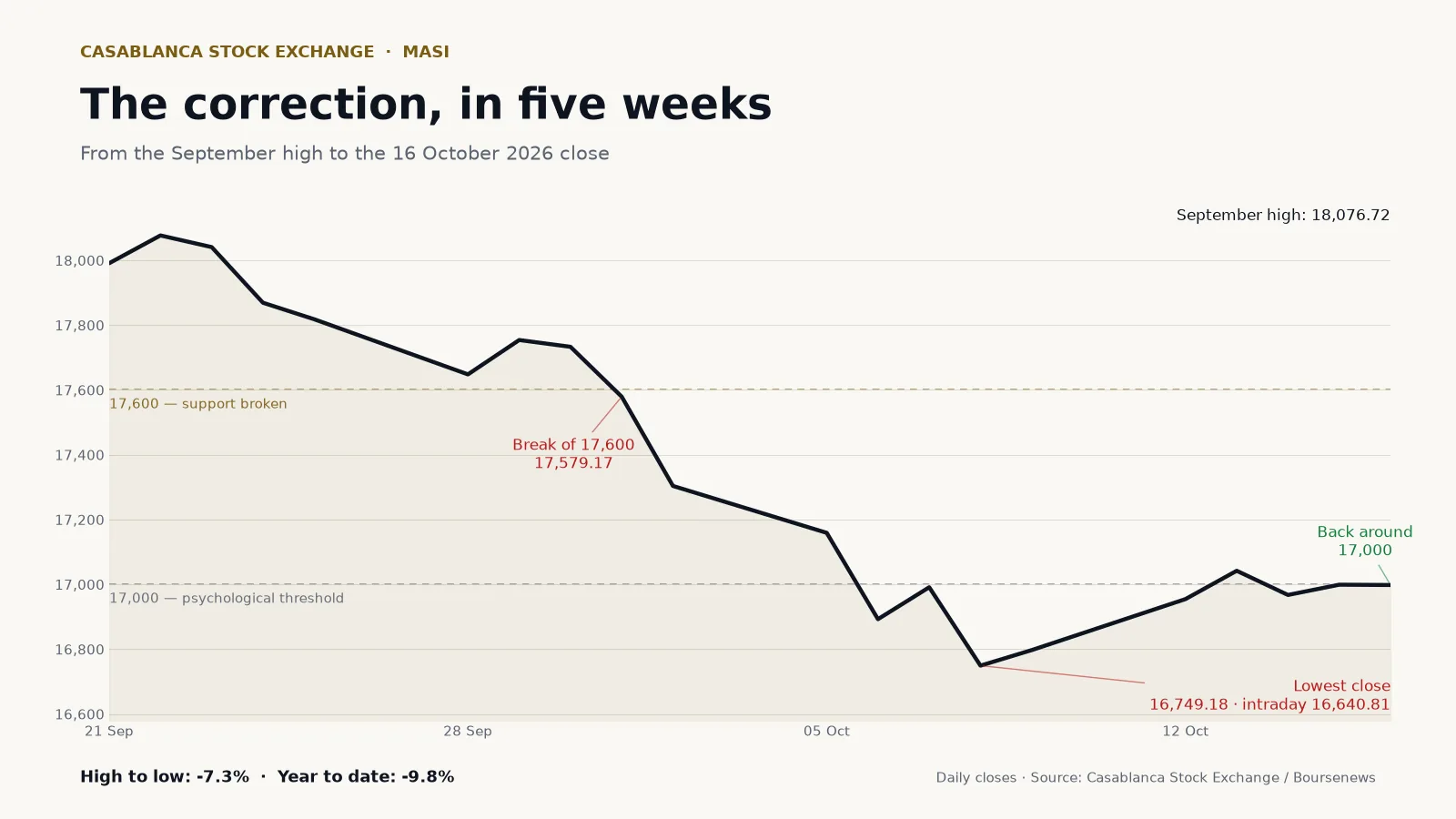
On 8 October, at the close, the MASI printed 16,749.18 points. I read the number twice. A week earlier it was still 17,579. In late September it had touched 18,076. In a few sessions, Casablanca’s benchmark index had erased months of patience, and the word “crash” began circulating in conversations.
It was not a crash.
It was a correction. But a correction that tells us something more interesting than a simple market move: it exposes the structure of a market that had climbed on one leg, with less and less liquidity, while the world around it was changing interest-rate regime. A correction is not just a fall in prices. It is a revealer.
The facts, without drama
Let us start with the numbers, because they already do half the work.
| Date | MASI close | Change | Volume* |
|---|---|---|---|
| 1 October | 17,579.17 | −0.87% | 152.5m MAD |
| 2 October | 17,303.69 | −1.57% | — |
| 5 October | 17,159.00 | −0.83% | 129.6m MAD |
| 6 October | 16,892.55 | −1.56% | 348.3m MAD |
| 8 October | 16,749.18 | −1.42% | 195.6m MAD |
| 9 October | 16,797.10 | +0.29% | — |
| 13 October | 17,041.91 | +0.52% | 186.1m MAD |
| 16 October | 16,997.92 | −0.01% | 117.4m MAD |
* Total volume on the cash market. Sources: Boursenews, Casablanca Stock Exchange.
From the 22 September high (18,076.72) to the 8 October closing low (16,749.18), the MASI lost 7.3%. Year to date, it is down 9.8%. The MASI 20, which tracks the twenty most liquid names, has done much worse: −17.1% since January. Market capitalisation slipped back below the symbolic 1,000 billion dirhams mark (999.89 billion on 16 October), after falling below it as early as 6 October.
Technically, the sequence is clear. The MASI had already failed below 19,100 points earlier in the year. It then broke the 17,600 / 17,625 support on 1 October, and the 16,850 support on 8 October, with an intraday low of 16,640.81 on 6 October. It now trades below its 20-, 50- and 100-week moving averages — but still above its 200-week moving average. That is the definition of a correction within a still-intact long-term trend, not a confirmed bear market.
This is not the end of the world. It is the end of a certain idea of the Moroccan market.
The mining leg buckled
The first cause is not mysterious. It is written in black and white in the first-half numbers: the Moroccan market of 2026 was a mining market.
Over the first six months, the mining sector index jumped 110.9%, led by Minière Touissit (+154.05%), Managem (+110.9%) and SMI (+46.34%). Since 2024, Managem is up 662% and SMI 357%, against roughly 99% for gold, 194% for silver and 74% for copper. That is no longer outperformance. It is a change of scale.
Then the yellow metal stopped explaining everything. Gold had hit an all-time high on 29 January 2026, before correcting by about 25%. On 22 September, an ounce traded around $4,325, roughly 22% below its peak. The miners, meanwhile, had already priced in much more than the metal.
The first-half results were spectacular — and that is precisely the problem. Managem reported 3.78 billion dirhams of net profit attributable to shareholders, against 380 million a year earlier. SMI rose to 243 million, CMT to 187 million. The mining sector as a whole produced 4.2 billion of profit, against 563 million a year earlier.
The market did not sell the miners because the results were bad. It sold them because they were exceptional — and the exceptional does not repeat. That is the difference between an earnings surprise and an earnings base. You can pay a high price for a base. You cannot pay a high price for a cyclical peak.
Earnings were narrower than the headline
The second cause is subtler, and more important for what comes next: earnings growth was much narrower than the aggregate number suggested.
In the first half of 2026, aggregate revenue for listed companies rose 10.7% to 190.8 billion dirhams. Excluding miners, the increase falls to 5.6%. Aggregate net profit attributable to shareholders rose 12.9% to 29.6 billion. But Managem alone accounts for nearly 3.4 billion of that change. Excluding Managem, aggregate net profit would have been broadly flat. And if you strip out both the miners and the one-off item booked by Maroc Telecom in 2025, profit growth drops to 4.3%. Excluding mining, aggregate operating profit would actually have fallen by 3%.
In other words: the market had bought a broad recovery; it received a concentrated one. The good numbers were real, but they came from a cyclical sector, in a market that had already paid for them. That is exactly what a headline put it in early October: “earnings are no longer enough to support the MASI.” Not because earnings had disappeared, but because they were already in the price.
It is a lesson we forget too quickly in Casablanca: an index is not an average of stories. It is an average of earnings, weighted by market capitalisation. When one stock explains most of the growth, the index rises with it — and falls with it.
The market had run out of liquidity
The third cause may be the most structural: the market no longer had enough liquidity to absorb even a modest exit.
Over the first nine months of 2026, total trading volume on the Casablanca Stock Exchange reached 71.47 billion dirhams, against 116.21 billion a year earlier — a drop of 38.5%. In September, volume was still down 48.8% year on year. In October, the sessions we have just lived through oscillated between 117 and 348 million dirhams of daily volume.
A thin market does not fall because everyone is selling. It falls because nobody is buying. That is a fundamental nuance: in a deep market, a seller finds a buyer at a slightly lower price. In a thin market, the seller finds a void. The price gaps. Stops trigger. Managers who need to trim do so in what they can sell, not in what they want to sell. And the index, being an average, records the passage from one void to the next.
A market capitalisation below 1,000 billion dirhams is not just symbolic. It is the sign of a market that needs flows to function, and no longer has them. The MASI 20, which represents the most liquid names, is down 17.1% since January: even the large caps, the ones that should reassure, are affected. On 16 October, Attijariwafa Bank, the most traded stock of the session, concentrated only 14 million dirhams of volume. This is not a market in panic. It is a market holding its breath.
The global rate shock
The fourth cause comes from outside, and it is probably the most underestimated by local investors.
On 15 October, US producer prices recorded their sharpest rise in four and a half years: +1.3% on the month, +6.3% year on year, with energy prices up 10.8% and gasoline up 20.3%. The possibility of a Fed rate hike was back on the table. Global long-term yields are already at levels unseen in more than two decades: the US 10-year Treasury trades above 5.1%, the German Bund around 3.6%, and Japanese government bonds are yielding at levels last seen in the late 1990s.
This is not a distant macro detail. It is the price of money. When the risk-free rate rises, every future cash flow is worth less, and every multiple paid yesterday looks more expensive today. Emerging markets, which depend on a strong dollar and a widening risk premium, feel it first. The Casablanca Stock Exchange is not an island: it is small, it is open to flows, and it has no liquidity cushion to absorb a global rate shock.
Add the geopolitical backdrop. On 15 October, a Boursenews article counted 135 targeted attacks against 84 critical infrastructure sites in the Gulf, hitting oil and gas facilities, desalination plants and refineries. Morocco is an energy importer. A lasting rise in oil means a heavier external bill, stickier inflation and a higher risk premium. Casablanca is not a war market; but it is a risk-premium market, and the premium rises quickly.
The market is digesting its own paper
The fifth cause is more local, and it deserves a straight look: the market has absorbed a lot of paper in a short time.
Since 2024, the Casablanca Stock Exchange has recorded 21 capital increases, raising nearly 17 billion dirhams. Add bond issues, free-share awards — such as Bank of Africa’s 51.2 million dirhams — and IPOs. On 16 October alone, TGCC raised 1.5 billion dirhams through a private placement.
In a market that trades 117 million dirhams a day, 17 billion dirhams of new paper is not a detail. It is direct competition for local savings that are not infinite. Every capital increase dilutes a little, but above all it absorbs cash that could have bought existing shares. Casablanca needs these operations to finance the growth of its companies; but it also needs investors to want to absorb them. The two do not always move at the same pace.
It is the law of supply and demand applied to equities. We forget it because we always look at the index from the demand side. But supply matters too.
The technical trigger: 17,600, then 16,850
We must separate the underlying causes from the trigger. The underlying causes explain why the market was fragile. The trigger explains why it fell now.
The 17,600 / 17,625 level had served as support several times in recent months. When it gave way on 1 October, it was not just a number that fell: it was a collective reference point. Stops triggered, technical models changed bias, and managers who needed to sell found a market without buyers. On 8 October, the close below 16,850 confirmed the move. The intraday low of 6 October, at 16,640.81, was the point of maximum stretch.
Then the market rebounded. On 13 October, the MASI moved back above 17,000, to 17,041.91. On 16 October, it finished almost flat at 16,997.92, up 1.19% on the week. A rebound, yes. A trend reversal, no — not yet. The first level to reclaim is the 17,600 / 17,850 zone. Below it, the short-term bias remains bearish. The support to watch remains 16,640 / 16,850. And the line between a correction and a bear market remains the 200-week moving average, still intact.
Technical analysis does not explain the cause. It explains the speed.
What this drop does not say
We also need to say what this drop does not say, because markets love stories that are too simple.
It does not say that the Moroccan economy is collapsing. International institutions have praised the resilience of the Moroccan economy; the banking system is not under stress; there is no sovereign shock. The Casablanca Stock Exchange is not the Moroccan economy. It is a small window into it, with its own flows, concentrations and moods.
It does not say that foreign investors are fleeing en masse. They carry little weight in a market dominated by local savings and Moroccan institutions. The decline is first a story of domestic liquidity and reallocation.
It does not say that the long-term trend is broken. The MASI remains above its 200-week moving average. A 7% correction in a market that had risen a lot is not abnormal. What would be abnormal is believing the decline is over because it was violent.
What to watch now
The next test is not the level of the MASI. It is volume.
A rebound towards 17,000 on 120 million dirhams of volume is not the return of savings. It is a technical rebound, sometimes just short covering. A genuine return of demand will show up in market depth, in the participation of non-mining stocks, and in the index’s ability to hold above 17,600 on rising volume.
The other things to watch:
- Gold and metal prices. Miners remain the index’s main engine. As long as gold does not stabilise, their risk premium will stay high.
- Second-half earnings, excluding miners. That is where the breadth of the recovery will be decided. If growth remains concentrated in Managem, the market will stay on one leg.
- Global rates and US inflation. Another high inflation print, or a US 10-year yield settling above 5%, will keep pressure on multiples.
- The Gulf conflict and the oil price. Morocco is an energy importer; every extra barrel weighs on the trade balance and on inflation.
- The capital-raising calendar. The market needs paper, but it also needs buyers. The pace of issuance matters as much as its quality.
- The 17,600 / 17,850 zone. It is the first serious resistance. Below it, the market remains in a corrective configuration.
What I take away
I do not know whether the low is behind us. Nobody does, and those who claim otherwise are selling something. But this correction reminded me of three things I do not want to forget.
The first is that an index is not an economy. Morocco can do well while the stock market falls; the stock market can rise while the economy suffers. They are two systems with two different clocks.
The second is that the quality of earnings matters more than their level. A profit driven by a commodities cycle is not the same as a profit driven by a customer base, pricing power or a strong balance sheet. The market eventually made that distinction. It was right.
The third is that liquidity is a promise you only notice when it disappears. A thin market can rise for a long time on one leg. It can even give the illusion of depth. Then one day it has to run — and it falls.
The MASI did not need a crash to be dangerous. It only needed to be thin, concentrated and illiquid at the moment the cost of capital was changing regime. So the right question is not “when will the MASI recover?” The right question is: what will put breadth back into this market?
As long as the answer is “the miners,” the market will stay on one leg. And a one-legged market can stand for a long time. Until the day it has to run.
Sources
- Boursenews, Bourse de Casablanca : Le MASI termine la semaine sur un gain de 1,19%, 16 October 2026. Link
- Boursenews, Le trou d’air des volumes, 6 October 2026. Link
- Boursenews, MASI : Biais baissier renforcé après la rupture des 17 600 points, 5 October 2026. Link
- Boursenews, Sans les minières, la croissance des revenus de la cote tombe à 5,6 %, 2 September 2026. Link
- Boursenews, Portée par les minières, la masse bénéficiaire de la cote progresse de 12,9 %, 2 October 2026. Link
- Boursenews, L’envolée des métaux fait les beaux jours des minières, 28 September 2026. Link
- Boursenews, Après l’envolée, Managem et SMI face au test de l’exécution, 2 July 2026. Link
- Boursenews, Taux obligataires : Pourquoi le monde emprunte plus cher, 25 September 2026. Link
- Boursenews, États-Unis : les prix à la production enregistrent en septembre leur plus forte hausse en quatre ans et demi, 15 October 2026. Link
- Boursenews, Conflit régional : L’impact des frappes ciblées sur les infrastructures stratégiques du Golfe, 15 October 2026. Link
- Boursenews, Près de 17 milliards de dirhams levés à travers 21 augmentations de capital depuis 2024, 13 October 2026. Link
Closing levels and volumes are taken from the market sheets published by Boursenews and the Casablanca Stock Exchange. Past performance is not indicative of future results. This article is a personal analysis and does not constitute investment advice.